
Institutional Governance, Land Strategy, and Legal Recognition of Local Communities in Faja Lobi
1. Vision and Founding Principles of Governance
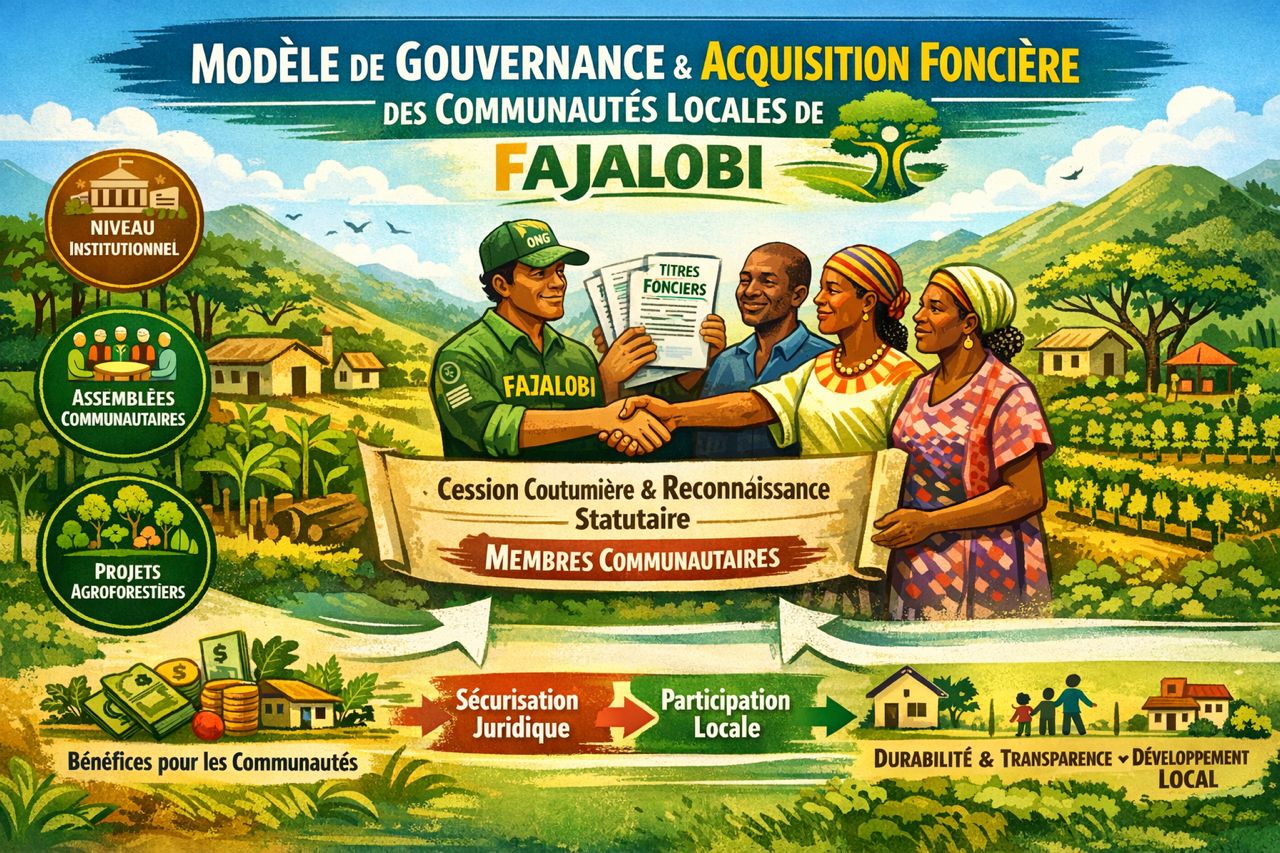
Faja Lobi’s governance is based on an integrated approach grounded in transparency, community participation, legal certainty, and environmental sustainability. It aims to ensure that reforestation and agroforestry projects are implemented within a stable, inclusive institutional framework focused on long-term impact.
This approach to governance is based on the principle of equitable partnership, in which local communities are recognized as full partners in Faja Lobi’s mission, rather than merely as beneficiaries.
2. Institutional Governance Framework
Faja Lobi's governance is structured around three complementary levels:
- The institutional level, managed by Faja Lobi as the project-implementing organization, is responsible for securing funding, administrative and financial management, compliance with environmental and social standards, and ensuring the legal security of land assets.
- The community level, represented by community assemblies, which bring together partner communities and participate in strategic decision-making, monitoring of activities, and the collective management of benefits.
- The operational level, which focuses on the technical implementation of projects in the field, including nurseries, reforestation, agroforestry, and monitoring and evaluation mechanisms.
3. Foundations of Community Land Partnerships
The land partnership developed by Faja Lobi is based on the recognition of customary rights as the legitimate foundation for access to land, combined with legal security in accordance with current land law. Even if the organization were to cease to exist one day, customary rights would remain guaranteed for the communities.
Local communities identify and make available land that is socially recognized, free of conflict, and suitable for the projects’ environmental and agroforestry objectives.
4. Mechanism for Acquiring and Securing Legal Title to Land
Following the community’s transfer of the land, Faja Lobi proceeds with the legal acquisition of the land and the registration of title, obtaining land titles registered in its name.
This approach aims to:
- Ensure legal certainty for investments;
- Prevent future land disputes;
- Ensure the continuity of projects after funding ends;
- Reassure technical and financial partners.
5. Land Acquisition and Legal Recognition of Communities
The land acquisition carried out by Faja Lobi does not constitute a loss of rights for local communities, but rather a process of transforming customary rights into recognized institutional rights.
The voluntary transfer of customary rights to the land allocated to the projects grants local communities formal status as members of Faja Lobi, as provided for in the organization’s bylaws. This status grants them a lasting right to participate in governance and to share in the benefits generated.
6. Types of Faja Lobi Members
In accordance with its bylaws, Faja Lobi consists of two categories of members:
- The statutory members, who helped establish Faja Lobi and are recognized as co-founders. Some are involved in day-to-day management and receive a salary, while others, who do not hold any executive positions, do not receive any compensation.
- Community members consist of local communities that have relinquished their customary rights to the land allocated to the projects in exchange for a customary fee and a long-term partnership. These communities are organized into community assemblies recognized by the bylaws.
7. Rights, Responsibilities, and Benefits of Community Members
Community members have clearly defined rights, including:
- Participation in community governance bodies;
- Access to the economic and social benefits resulting from the projects;
- Participation in community-based monitoring of activities.
They also assume responsibilities such as protecting sites, fulfilling contractual obligations, and participating in group activities.
8. Economic Governance, Redistribution, and Accountability
The profits generated by Faja Lobi’s projects, including those derived from the monetization of environmental assets, are primarily allocated to member communities, in accordance with transparent mechanisms that have been collectively approved.
Faja Lobi acts as an institutional manager and steward of accountability, ensuring financial transparency, the traceability of resources, and regular reporting to communities and partners.
9. Governance Focused on Sustainability and the Post-Project Phase
By combining land tenure security, legal recognition of communities, and participatory governance, the Faja Lobi model ensures the sustainability of projects beyond funding cycles.
This model strengthens local ownership, mitigates institutional and land-related risks, and anchors Faja Lobi’s work within a framework of sustainable socio-environmental development that benefits both present and future generations.
Does this news story make you feel a certain way?
Have a question, a comment, or something you'd like to share? The team reads everything and responds.
Did you like this format?
Faja Lobi relies on private donations. Every contribution helps fund seedlings and salaries in Idiofa.
— Share this resource
— Other News
— Other media
— Other Reports